Sometimes, the Best Thing to Do Is Destroy the Book
On Clarice Lispector’s The Hour of the Star
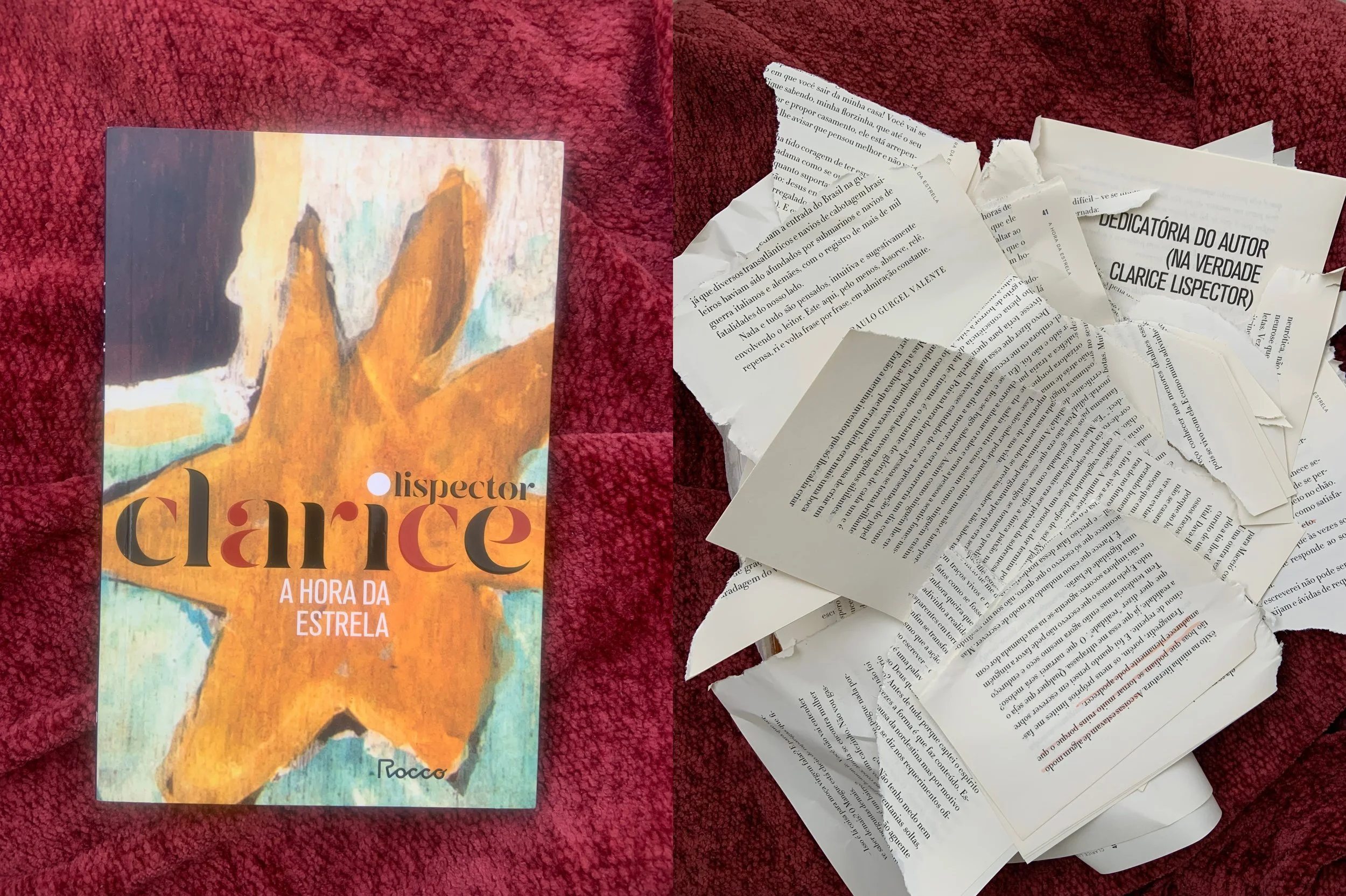
I have read hundreds of books and, needless to say, many of them were disappointing. However, few triggered such a visceral reaction that they made me decide to physically destroy the book. And that is what Clarice Lispector’s The Hour of the Star did to me. I will not keep it in my library, and I will not pass it along. Nobody should read this – recycling it is. Even as someone who reads a lot of heavy material, I have not been this shocked by a book in years. Some things are simply difficult to write and read, but an author who deliberately chooses narrative tools that reproduce violence is a different matter entirely.
My greatest ethical and aesthetic issue with this novel is the fact that an established woman author chose to narrate poverty and violence through the lens of a privileged, egocentric, judgmental, arrogant, and invasive male narrator. She uses her technique and platform to amplify the male gaze and patriarchal discourse instead of centering her supposed protagonist. And she does so deliberately – Rodrigo S.M. is not just a narrator, but Lispector's own alter ego, her chosen self-representation. Critics have defended this as a formal solution, an ironic device. But the question they fail to ask is: why is your alter ego an arrogant man? What does it mean to construct a male mask for yourself to look down at a poor woman you claim to be writing about? Irony does not neutralize the harm. It aestheticizes it. Macabéa is a thing, an object of study. As someone who does not know how to think, who wants nothing from life, is extremely stupid, and then simply dies, she is rendered completely irrelevant. She merely exists – then stops existing – but does not even seem to be aware of her own existence. The author turns her into a vehicle to perform male arrogance. And I asked myself: who was this story written for? But the answer does not matter – given the context, regardless of who it was directed at, it remains problematic.
Lispector was not unfamiliar with poverty – she experienced it herself as a child refugee. Which makes her choices here even harder to defend. As someone who knew from the inside that there is more to a marginalized woman than what a privileged man can see, why construct an arrogant male alter ego to narrate Macabéa's life? Why choose to look at this woman from the outside, through a gaze she herself might have been subjected to, rather than draw on what she actually knew? If she truly wanted to denounce injustice, she could have written from her own position and exposed the systems she had come to benefit from. Instead, she admitted she could not tell this story adequately – and told it anyway. It was not hers to tell, and she knew it.
This critically acclaimed novel does many other things wrong – to be honest, it does nothing right – including trivializing sex work, painting a reductive picture of the complex love between lesbians and women, and reinforcing male voyeurism. As a woman, why give more voice to men when women are already silenced? Why not explore and expand the humanity and complexity of women? This pattern of reproducing the inequalities that people seem to believe she was trying to expose (did we read the same book?) is the reason it is almost impossible to believe in the solidarity of white women. These narratives reinforce what they claim to denounce: symbolic power and outsiders making money ridiculing poor women. The reason people love this book is not because they care about Macabéa, what she represents, or the material conditions of poor women – it’s poverty porn masked as social awareness. What people are actually responding to when they say they love this book is Lispector’s meta-narrative games and her self-referential narrator – not to Macabéa. Her character is incidental. She is the vehicle for Lispector’s performance of literary genius. People praise the author while the character is rendered subhuman. That is exactly the problem – the character’s dehumanization is aestheticized and celebrated as technique. This is why I cannot take people like Lispector seriously.
And is it not bitterly ironic that Carolina Maria de Jesus, who was barely considered an author by so many privileged circles, still died poor after her own story was – and continues to be – read around the world? Her most famous book became a global sensation for the same reasons – her suffering was consumed as entertainment, as something exotic and shocking, not as a call to action. People read it, feel good about themselves for doing so, and nothing changes. That is not solidarity. It is suffering porn.
What all of this reveals about power is that literary works like this one are canonized because of the prestige attributed to their author – people seem to think Lispector was a genius. We cannot deny that the establishments she was part of love to write and consume meta-narrative experiments carried out at the expense of marginalized communities. What better way to feel good about yourself than to reinforce your symbolic consumption of marginalized communities? Those who claim this book is a cultural reference that highlights representation and demands justice are trying to hide the reality of existing power structures in literature – they do not care, and there is no gentle way to say that.
I hated having to write this piece because I also wanted to avoid giving this book more exposure, but it is important to say how bad it really is. So, I want to end by redirecting attention to other women who write from lived experience and/or honor the complex realities of women better. In a piece about Brazilian literature and the dehumanization of poor women, it would be impossible not to name Carolina Maria de Jesus, Conceição Evaristo, and Lilia Guerra. I also want to highlight other women who do the same in their fiction, their essays, their poetry, their theory: Jarid Arraes, Adelaide Ivánova, Françoise Ega, Buchi Emecheta, Oyèrónkẹ́ Oyěwùmí, Tamara Isaac, and many more.
The literary canon needs to start reflecting stories that are told in an authentic and ethical way so that people stop confusing active betrayal with genius. Brazilian (and global) literature deserves better than this – and so do we as women.
