When Discomfort Becomes Conservatism
This post doesn't aim to teach about liberalism or conservatism. Google and books do that. I want to use this social media dynamic as a case study to understand certain patterns of political choices.
For context, I came across this page a few years ago and participated in a couple of book club sessions because I was looking for spaces where I could connect with other autistic people who shared my interests. I vaguely remember mentioning I would have loved to see more POC in the space, which resulted in the creation of a sub-group for POC in the book club. I never even got to participate in it because I had to prioritize other things. This was the extent of my connection to this group, so I do not know the coordinator beyond the couple of group interactions and a few messages exchanged on Meetup. I don’t think she even knew who I was on Instagram.
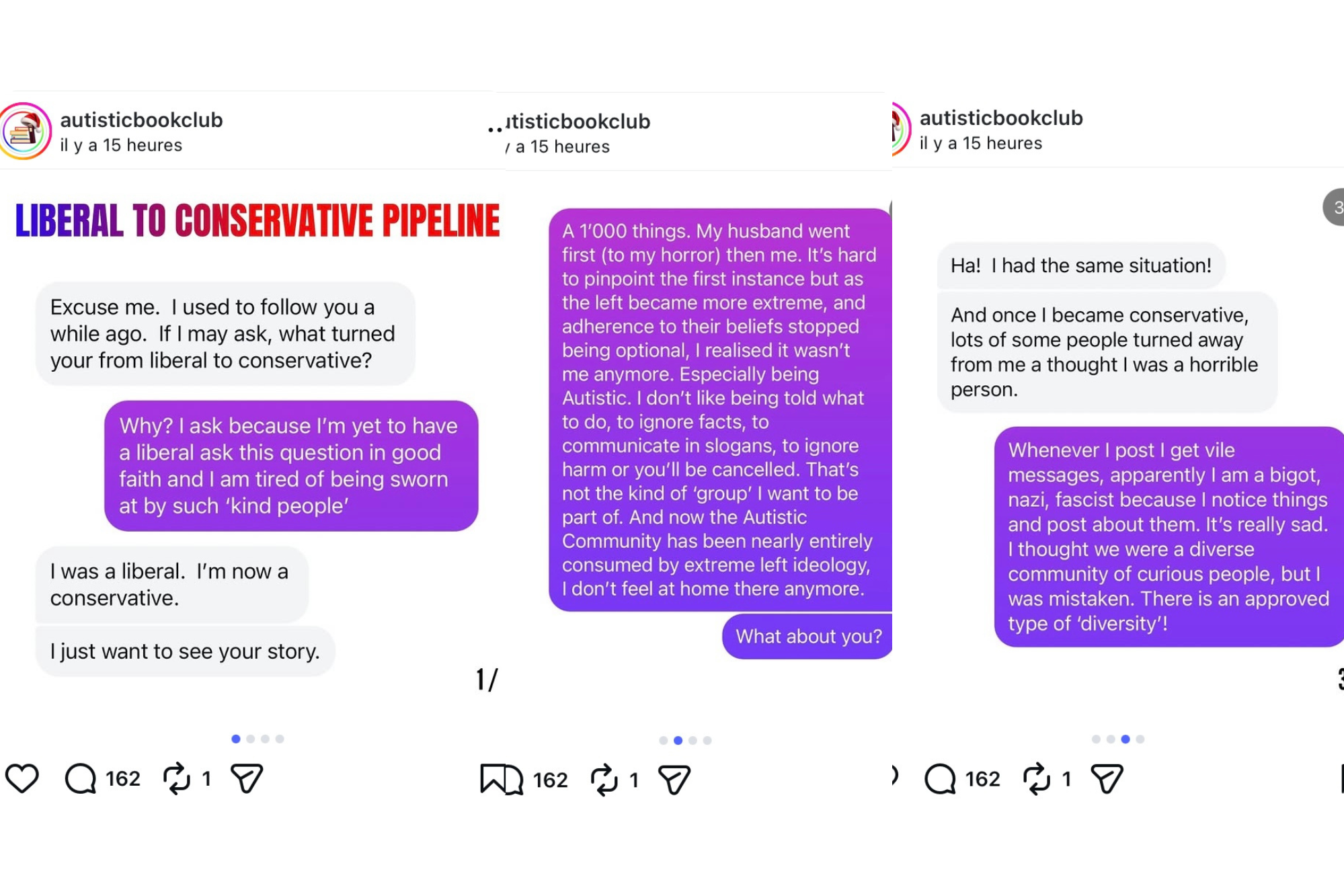
Screenshots of the original post.
The first thing that stood out to me when I read the post was that these two people understood conservatism as being distinct from liberalism. They are both fundamentally right-wing ideologies. However, assuming people understand that liberal means left, the choice to shift from left to right is interesting, especially given the arguments used to support that position. I shared my thoughts about this dynamic on my Instagram story, never directly engaging with her, and was promptly blocked. This response itself illuminates much of what I want to discuss.
The left - and political ideologies in general, but particularly the left - exist on a wide spectrum where ableism is indeed strong. But this was not always historical or based on defined values - it’s related to how people decide to practice ideologies they don’t fully understand and the glorification of “radical” movements. This romanticization often occurs without knowing or acknowledging that they are still plagued by conservative values, which society, as we know it, was built on. And the spectrum of political positions on one “side” is an argument people understand very easily when it comes to the “right,” even though their values have always been unequivocally, consistently, and explicitly problematic, yet when the “left” articulates its principles, it is “self-righteous.”
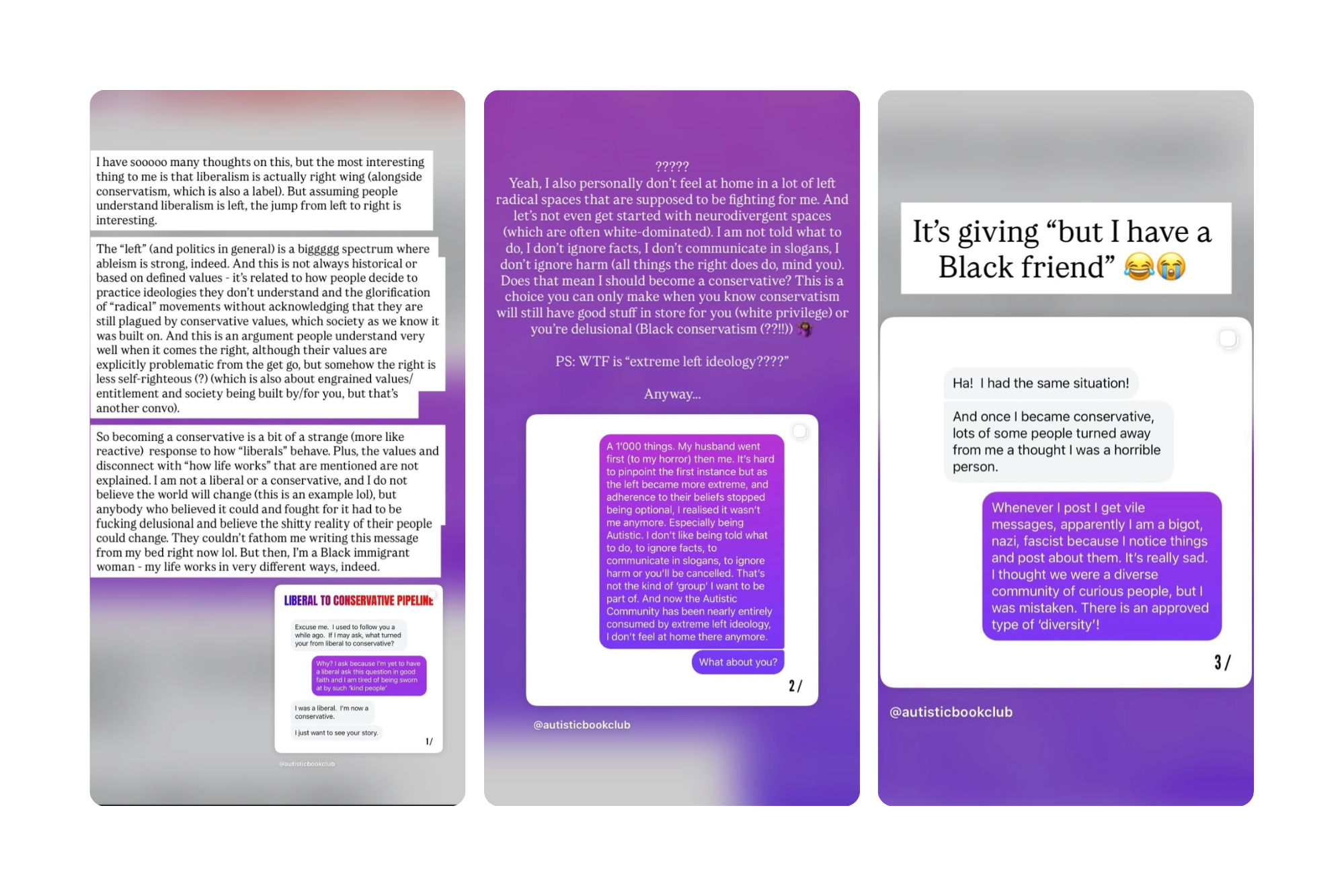
My brief comments on the post in my stories.
This perception of the right being less “self-righteous” also stems from the fact that they exist and thrive in a sociopolitical system that was built by and for them. This translates into entitlement - they don’t have to explain why they stand where they stand or examine how their values and choices impact others’ realities. They also expect people to try to understand them without ever having anything to lose. It’s also worth highlighting that right-wing propaganda is often so pervasive that the system feeds itself, and when they are loud, it’s expected; they dominate society anyway. When the “left” speaks up, it disrupts the established order.
The normalization of “right” values and their impact is the reason why the “left” needs to be louder and more uncompromising. Being unwilling to negotiate around values and practices that threaten one’s very existence is not self-righteousness - it’s survival. I am not obliged to do the emotional labor of being “curious” about people whose (racist, xenophobic, sexist, ableist, homophobic, etc.) values have dehumanized people like me since the beginning of time, while they get to call the demand for accountability “extreme left ideology.” And frankly, some beliefs are not optional.
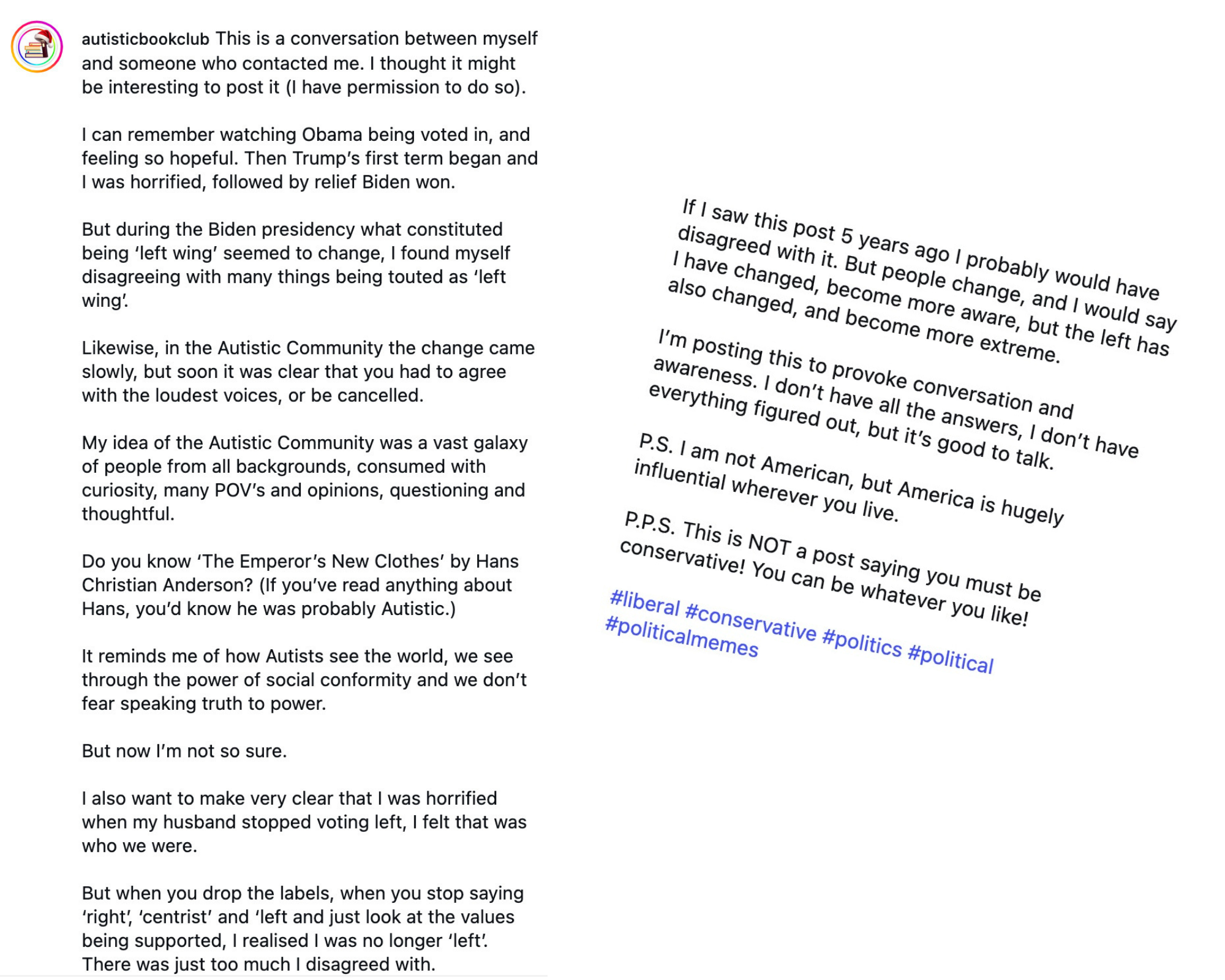
The caption of the original post.
Even using the shift from Obama to Trump to Biden to justify moving from left to right is perplexing. Biden misrepresenting the left made them choose conservatism? It’s also interesting that they can easily question left-presenting values and practices that don’t align with what they believe the “left” should be, but conservatism does not contradict those values? Which right-wing values are being chosen over left-wing ones here? What left-wing values make them uncomfortable?
Of course, this is not about them having an issue with fundamentally left-wing values. It’s about privileged people having the option to switch sides as soon as we demand that they abandon their comfort to do more work. So choosing to become a conservative is simply a reactive (almost revengeful) response to “liberal” values and behaviors. I, a Black Haitian autistic immigrant woman, will have to live uncomfortably every day because, no matter which “side” I pick, I have been and will be let down at some point. I have sat in radical left spaces that loudly advocate for collective Black liberation but are filled with sexist and ableist people who also have poor human literacy when it comes to their interpersonal relationships. Does that mean I get to (or should) become a conservative?
The author of the post also makes a series of accusations against the “left,” but does not offer any concrete examples. In fact, the mention of feeling hurt when called out after saying things seen as bigotry or fascism indicates that this person simply feels uncomfortable being called out. She is more interested in prioritizing her individual comfort over collective harm. And she proved that when she blocked me after reading my stories about her post, asked if I was trying to have a go at her, and decided I was before I could even answer. Her post claims that she does not have all the answers, wants to spark conversation, and that “leftists” are the ones not open to constructive conversations, though. Her question also perfectly illustrates how I - a person living at the intersection of multiple marginalized identities - am expected to coddle a white woman’s feelings and educate her, even though she doesn’t think twice before blocking me or choosing to embrace a political ideology that fundamentally violates my existence.

The message the author sent in reply to my stories before blocking me.
Starting her message with “I am not an academic…” and being worried that I was having a go at her is lazy and disingenuous. She conveniently skipped my political analysis and tried to position intellectual work as elitist and almost like a moral failure - because you know, “poor people who choose not to pick up a book even when they run a book club or refuse to watch an educational video.” Ironically, this obsession with being attacked is textbook liberalism that focuses on individual comfort rather than collective well-being. But regardless of how I had framed my comments, which analyzed a pattern of individual choices rather than condemning one person, I would have received the same response from people who have not explored the complex spectrum of political stances.
The last piece I found interesting was the mention of the “left” being interested in an “approved type of diversity.” The concept of diversity did not evolve to include and understand white people. DEI literally became a huge thing because non-white people from various backgrounds are still being systemically excluded everywhere! So, how is diversity about white people and their comfort in the “community?” And yes, many times, left-wing POC - and other marginalized groups - building diverse and inclusive spaces will mean actively excluding white and other privileged people. This complaint also clearly shows that she is more interested in being included and feeling comfortable in every space rather than building real inclusive spaces, even when it means she will hear things she does not like.
At the end of the day, this proves that only the “right” is allowed to be incoherent and fallible in their values and practices - they get to try to convince you to drop all labels because the “left” has become too radical, while publicly assuming themselves as part of a right-wing ideology. The worst part is, they don’t even have to learn what any of those political words mean.
Thank you for reading. If this resonates, feel free to share, comment, and follow.
This essay was originally published on my Substack newsletter, Unmapped Poetics. Subscribe here for weekly essays on literature, diaspora, and politics that challenge dominating narratives.
If you’d like to support my work, you can tip me here.
